
Primary source
The Five Dysfunctions of a Team
book_cube summary post with practical notes and cross-references to adjacent leadership models.
Primary source
The Five Dysfunctions of a Team
book_cube summary post with practical notes and cross-references to adjacent leadership models.
The Five Dysfunctions of a Team: A Leadership Fable
Authors: Patrick Lencioni
Publisher: Jossey-Bass
Length: 2002
A 2002 business fable where Patrick Lencioni uses a leadership-team crisis story to explain five failure patterns and concrete recovery tactics.
 Original
Management / Leadership / Culture / Processes / Thinking
The Five Dysfunctions of a Team works because it combines narrative and framework: the first part shows team failure in context, the second part gives a practical operating model for leaders.
1. Story and leadership context
The story starts in a once-successful tech company that lost collaboration discipline: teams optimize local agendas, delivery slows down, and quality declines. Kathryn, the new leader, does not begin with tooling. She diagnoses leadership dynamics first. That is the core lesson: delivery problems often start with team behavior, not process mechanics.
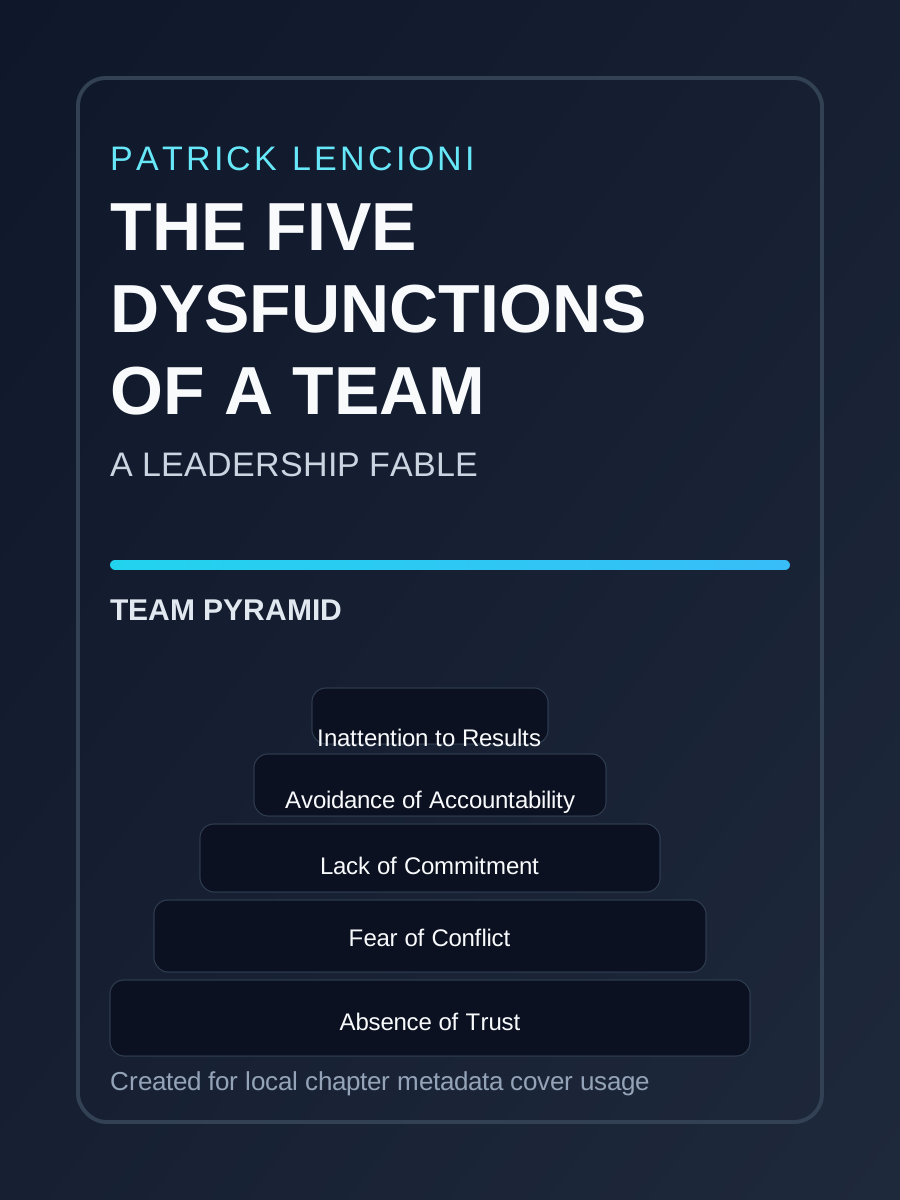
2. The five-dysfunction pyramid
Layer 01 · Foundation
Absence of trust
Signal: People hide mistakes, avoid asking for help, and spend energy on self-protection instead of collaboration.
Leader action: Model vulnerability at leadership level, run honest retrospectives, and treat mistakes as process signals rather than reasons for blame.
Layer 02 · Level 2
Fear of conflict
Signal: The team avoids hard topics, accepts polite compromises, and moves real disagreements to private channels.
Leader action: Separate personal conflict from professional debate, define discussion rules, and surface disagreements in the room.
Layer 03 · Level 3
Lack of commitment
Signal: After meetings, decisions remain unclear: no owner, no deadline, no execution checkpoint.
Leader action: Record every decision in writing with owner, due date, done criteria, and a follow-up review point.
Layer 04 · Level 4
Avoidance of accountability
Signal: Peers avoid direct feedback on quality, deadlines, and team commitments; standards slowly decay.
Leader action: Make peer accountability explicit: shared quality standards, visible commitments, and permission to challenge constructively.
Layer 05 · Top
Inattention to results
Signal: Personal goals, status, and local wins become more important than team and business outcomes.
Leader action: Tie role goals to shared outcomes and track progress on a single visible team scoreboard.
3. Fast diagnostic checklist
- Meetings end without an owner, timeline, and next step.
- Hard topics are discussed in side conversations after the meeting.
- Risks and mistakes are discovered late, when correction costs are already high.
- The team protects comfort, but not decision quality.
- Reports optimize individual progress instead of team outcomes.
4. Where it aligns with other models
Project Aristotle (Google)
Psychological safety directly maps to Lencioni's trust foundation: without trust, teams avoid hard debate and learning.
Open sourceProject Oxygen (Google)
Manager behaviors around clarity and accountability support the middle layers of commitment and peer accountability.
Open sourceWestrum culture typology
Moving from bureaucratic/pathological patterns toward a generative culture strengthens trust, conflict quality, and results orientation.
Open source5. Common anti-patterns
Confusing trust with permanent niceness and avoiding hard professional conversations.
Treating every conflict as destructive and shutting debate down early.
Running status-heavy meetings without explicit decisions and ownership.
Relying only on top-down control instead of peer accountability.
Optimizing local KPIs while hurting overall flow outcomes.
Using individual heroics to patch systemic team issues.
6. Recommended patterns
Open key sessions with clear context: goal, constraints, expected decision.
Write down outcomes of every discussion: decision, owner, due date, status check.
Run regular conflict reviews before disagreements become personal.
Introduce peer feedback on quality and commitment reliability.
Connect individual goals to common team and business outcomes.
Review incidents through a system lens instead of searching for a person to blame.
7. 30-day rollout plan
- Week 1: assess the five dysfunctions in leadership team dynamics and define 2-3 root issues.
- Week 2: enforce meeting decision templates (owner, due date, done criteria) and a shared decision log.
- Week 3: launch open conflict review sessions and peer feedback on commitments.
- Week 4: align individual goals with shared outcomes and run a retrospective on behavior changes.
The book was written in 2002, and some examples are era-specific. The durable value is the diagnostic baseline: weak trust and unclear accountability invalidate even strong process design.