
The Laws of Simplicity
Authors: John Maeda
Publisher: MIT Press
Length: 2006
John Maeda's ten laws as a practical lens for balancing complexity and simplicity in products, processes, and engineering decisions.
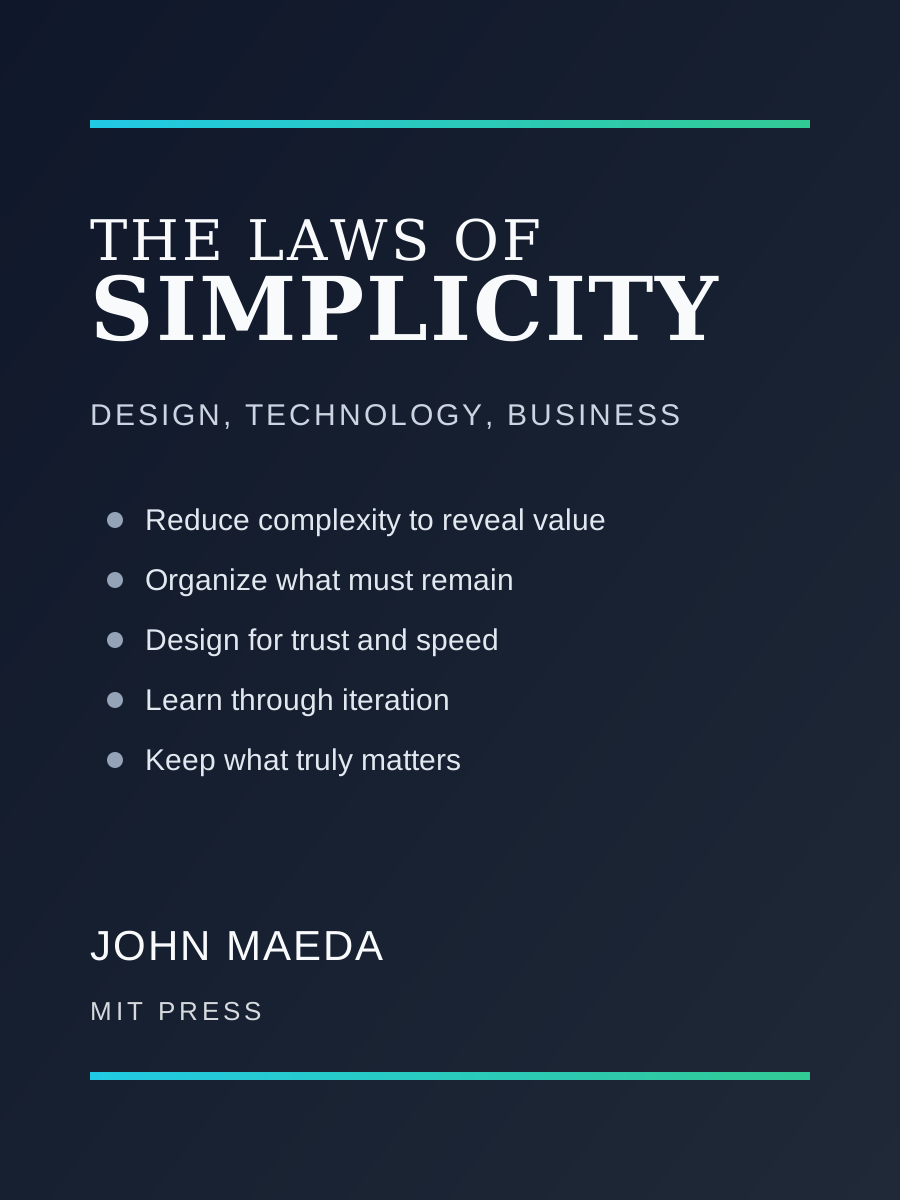 Original
Brief
The essential idea
Published in 2006, John Maeda's The Laws of Simplicity is most useful as a set of design questions rather than a strict scientific theory. The ten laws are Reduce, Organize, Time, Learn, Differences, Context, Emotion, Trust, Failure, and The One: subtract the obvious and add the meaningful.
For engineering teams, simplicity is not merely fewer interface elements. It can mean faster builds and reviews, predictable ownership, useful documentation, transparent system behavior, and lower cognitive load. Context, trust, and learning determine whether an apparently simple process is actually usable and safe.
Reduction becomes harmful when it removes security, observability, support, or important domain constraints. Effective simplicity preserves value and operational truth, tests both happy paths and failures, and treats unsuccessful simplification attempts as inputs to another experiment.
Decision lens
Key takeaways
Reduce deliberately, but protect the functionality and controls that create real value.
Organization can make a capable system understandable without removing its options.
Time savings are experienced as simplicity in frequent engineering workflows.
Learning lowers the cognitive cost of systems, processes, and tools.
Context, emotion, and trust shape whether a product or process feels clear and safe.
Failure is part of finding an appropriate level of simplicity.
The goal is focus on the meaningful, not minimalism for its own sake.
Workplace experiment
Apply it at work
- 1
For one process, record what can be removed, what must remain, and how time saved will be measured.
- 2
Review a frequent engineering loop such as build, review, deployment, or incident recovery for needless steps.
- 3
Map dependencies, edge cases, users, and operational risks before simplifying a system or interface.
- 4
Test the proposed simplification during failures, escalation, and manual recovery as well as the happy path.
Choose one action, define the observable effect, and keep the first test small enough to reverse.
Evidence
Sources and further reading
Primary source
Additional sources
Channel, aggregator, and commentary links confirm the work; they are not the primary source.