
Designing Your Work Life
Authors: Bill Burnett, Dave Evans
Publisher: Knopf
Length: 305
Applying design thinking to a career through reframing, the four R strategies, career prototypes, and a four-week change plan.
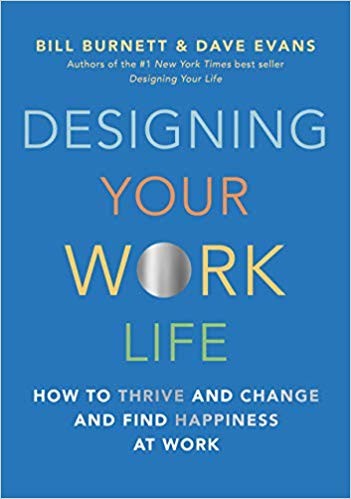 Original
 Translation
Brief
The essential idea
Designing Your Work Life applies design thinking to a career: satisfying work is designed through diagnosis, reframing, options, prototypes, and evidence rather than discovered in one perfect job. For engineers, the analogy is a legacy-system refactor—make small reversible changes before attempting an architectural replacement.
The method favors action, a Minimum Actionable Problem, and good-enough-for-now improvements. It separates gravity problems that must be accepted from actionable problems and evaluates satisfaction through ARC: autonomy, relatedness, and competence.
Before resigning, the four R strategies offer different experiments: Re-enlist around a renewed purpose, Remodel the work mix, Relocate to another team or product, or Reinvent the track within the organization. A four-week plan uses an energy diary, a backlog of career hypotheses, information interviews, shadow rotations, role one-pagers, success metrics, and a WIP limit.
Decision lens
Key takeaways
A career can be prototyped and iterated instead of solved as one irreversible choice.
Reframing turns a vague complaint into a small testable problem.
Gravity problems must be accepted before effort is invested in actionable ones.
Autonomy, relatedness, and competence provide a useful scan of work satisfaction.
Re-enlist, Remodel, Relocate, and Reinvent offer alternatives to immediate resignation.
If experiments fail, a constructive departure should preserve commitments, evidence, and relationships.
Workplace experiment
Apply it at work
- 1
Keep a five-day energy diary and turn one recurring frustration into a measurable two-week problem.
- 2
Create ten career hypotheses, choose one high-impact low-cost experiment, and define its stop date.
- 3
Conduct two or three information interviews and arrange a shadow experience in a target team or role.
- 4
Write a one-page proposal describing what to remove, what to add, the team benefit, risks, and validation metric.
Choose one action, define the observable effect, and keep the first test small enough to reverse.
Evidence
Sources and further reading
Additional sources
Channel, aggregator, and commentary links confirm the work; they are not the primary source.