
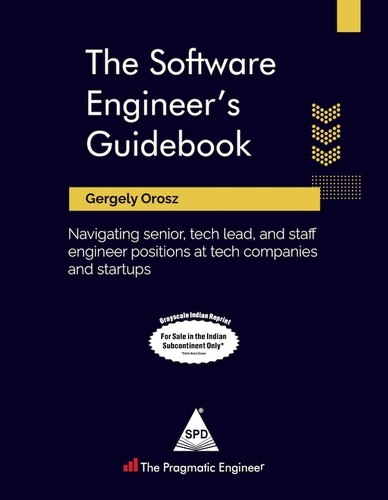
The Software Engineer's Guidebook
Authors: Gergely Orosz
Publisher: The Pragmatic Engineer
Length: 2023
A practical guide from junior to Staff+: competency growth, preparation for review and promotion, environmental influence, and deliberate career focus.
 Original
 Translation
Brief
The essential idea
The Software Engineer's Guidebook is an IC-career navigator from the first years of development through Senior, Tech Lead, Staff, and Principal levels. It combines technical fundamentals, career strategy, and organizational context rather than reducing progression to completing more tasks.
Its structure covers career ownership, performance review and promotion, durable implementation, engineering practices, architecture trade-offs, project delivery, stakeholder work, business context, reliability, and influence without authority. Different environments—such as a startup and Big Tech—reward different strategies and should be chosen for the current career stage.
The book is most useful as a working reference. Engineers can keep a record of outcomes, gather promotion evidence months before calibration, compare current behavior with next-level expectations, and turn gaps into two or three quarterly development hypotheses discussed with their manager.
Decision lens
Key takeaways
Career ownership includes collecting evidence, seeking feedback, and making a manager an ally.
Promotion preparation begins months before the review rather than during the final week.
Next-level signals include coordination, influence, and predictable execution—not only volume.
Technical foundation and organizational impact both matter as scope increases.
Startup and Big Tech contexts require different career and execution strategies.
The guide can function as a desk reference, review checklist, growth plan, and competency map.
Workplace experiment
Apply it at work
- 1
Start a career evidence log covering outcomes, artifacts, metrics, and feedback.
- 2
Map current behavior to the expectations of the next level and identify the largest two gaps.
- 3
Create two or three quarterly development hypotheses tied to real work and review them in one-to-ones.
- 4
Evaluate whether the current company environment supports the skills and scope required for the next stage.
Choose one action, define the observable effect, and keep the first test small enough to reverse.
Evidence
Sources and further reading
Additional sources
Channel, aggregator, and commentary links confirm the work; they are not the primary source.