
The Effective Software Engineer
Authors: Addy Osmani
Publisher: O'Reilly Media
Length: 200+
How engineers move from output to outcome through strong fundamentals, influence without authority, awareness of anti-patterns, and AI as a leverage tool.
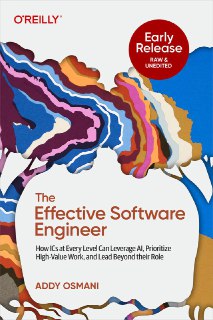 Original
Brief
The essential idea
Addy Osmani's The Effective Software Engineer shifts the goal from writing more code to creating measurable value for users and the business. Efficiency asks how well a task is executed; effectiveness asks whether the right task was chosen. IC growth increasingly depends on the latter, supported by metrics and feedback rather than output volume.
Across 13 chapters, the book connects maintainable code, testing, debugging, Git, and written communication with T-shaped expertise, architecture trade-offs, technical debt, cross-functional influence, leveling, strategic initiative selection, sustainable work, distributed teams, and visibility of contribution.
AI is treated as an amplifier for drafts, PR analysis, and test-case generation—not a replacement for engineering fundamentals or accountable architecture decisions. For Staff+ engineers, the repeatable mechanisms of influence are RFC and ADR, risk synchronization, deprecation plans, technical roadmaps, and clear evidence of impact across teams.
Decision lens
Key takeaways
Effectiveness means choosing work that changes a valuable outcome, not maximizing personal output.
Strong code, testing, debugging, and documentation remain multipliers at senior levels.
T-shaped engineers combine deep expertise with a broad systems view.
Heroism, knowledge silos, over-engineering, NIH, perfectionism, and analysis paralysis limit impact.
Staff+ growth comes from repeatable influence and larger scope rather than more sprint tasks.
AI should accelerate routine stages while humans retain responsibility for trade-offs and architecture.
Workplace experiment
Apply it at work
- 1
Define the expected product or operational outcome before starting each major task.
- 2
Maintain a lightweight decision log and review the hypothesis after two to four weeks.
- 3
Remove one recurring personal anti-pattern such as endless refactoring or context switching.
- 4
Use AI for drafts, PR analysis, or test cases while keeping design decisions and verification explicitly human-owned.
Choose one action, define the observable effect, and keep the first test small enough to reverse.
Evidence
Sources and further reading
Additional sources
Channel, aggregator, and commentary links confirm the work; they are not the primary source.