
The Model Thinker
Authors: Scott E. Page
Publisher: Basic Books; МИФ
Length: —
Scott E. Page on combining multiple models to reason about complex systems and avoid narrow, single-theory decisions.
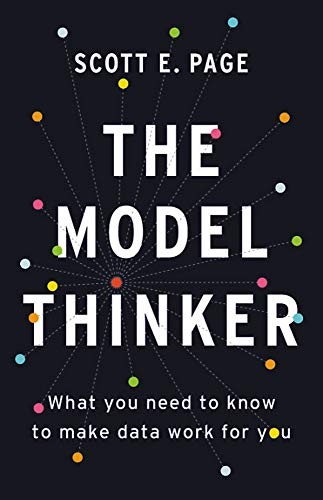 Original
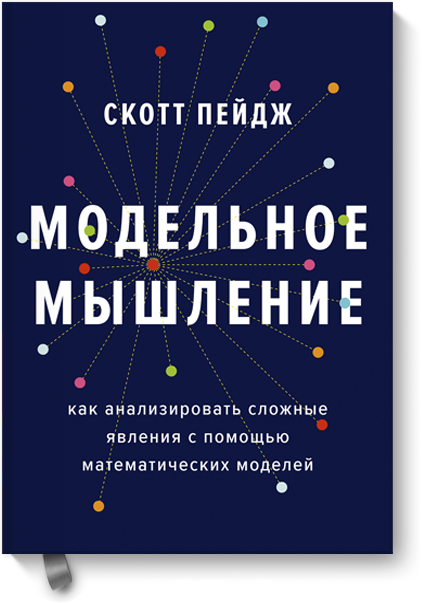 Translation
Brief
The essential idea
Scott E. Page argues that complex systems rarely yield to one correct theory. A model is a purposeful simplification with entities, relationships, rules, predictions, and limits; stronger reasoning comes from combining models that make different errors rather than forcing every problem into one familiar explanation.
Useful families include causal, probabilistic, network, incentives and choice, system-dynamics, and diversity models. The REDCAPE framing connects them to reasoning, explaining, designing, communicating, acting, predicting, and exploring, while a practical decision protocol records each model's forecast, failure conditions, evidence, combined conclusion, risks, and triggers for revision.
Decision lens
Key takeaways
A model is valuable because it simplifies reality in a transparent and testable way.
Every model has a domain where it is useful and a boundary where its conclusions become unreliable.
A portfolio of independent models is usually more robust than a single favored model.
Causal, probabilistic, network, incentive, dynamic, and diversity lenses expose different mechanisms.
Models should make predictions that can be checked against data and counterexamples.
Treating a metaphor as a model, ignoring evidence, or extrapolating from one team to an organization are common errors.
Technical leaders can apply model portfolios to roadmaps, architecture, organizational design, risk, and postmortems.
Workplace experiment
Apply it at work
- 1
Take one stuck problem and describe it with at least three models based on different mechanisms.
- 2
Write each model's prediction, applicability boundary, and the evidence that would show it is wrong.
- 3
Select two or three observations or metrics that discriminate between the predictions.
- 4
Combine the conclusions into a decision memo with risks and explicit revision triggers.
- 5
Review the decision after a week and update the models from the new evidence.
Choose one action, define the observable effect, and keep the first test small enough to reverse.
Evidence
Sources and further reading
Primary source
Additional sources
Channel, aggregator, and commentary links confirm the work; they are not the primary source.