
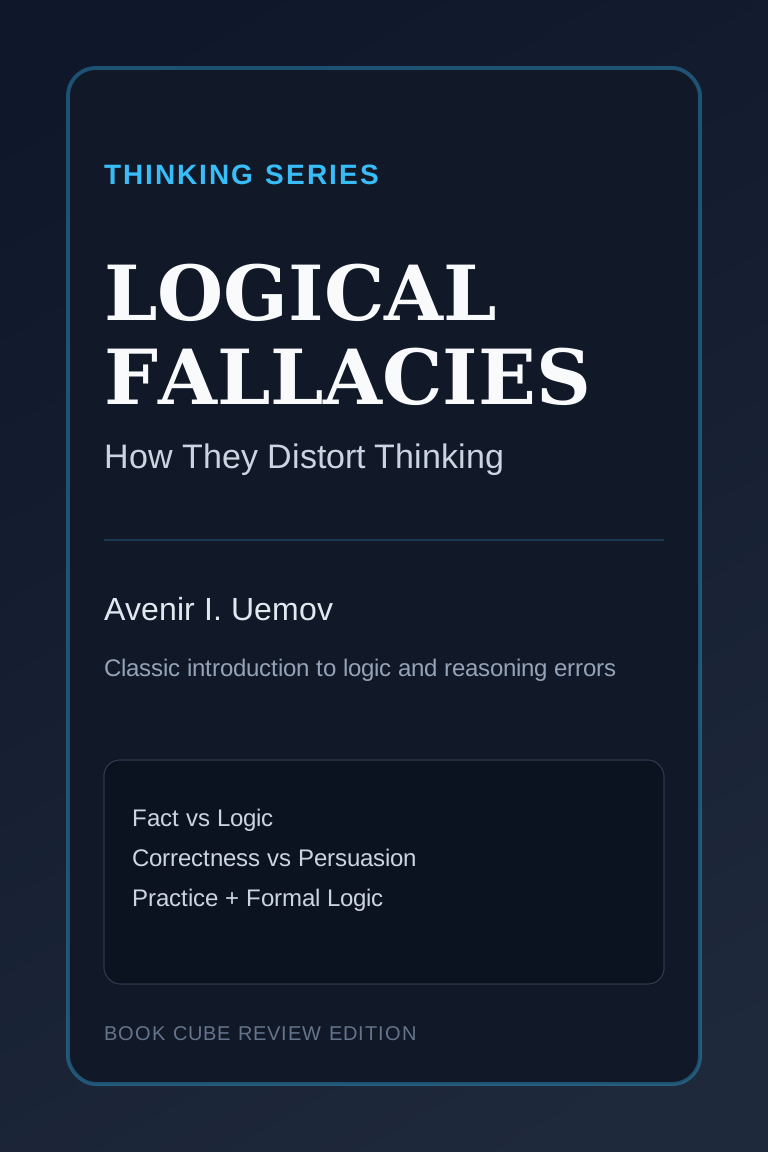
Логические ошибки. Как они мешают правильно мыслить
Authors: Авенир И. Уёмов
Publisher: Учебник 1958 года (современный репринт)
Length: 1958
Avenir Uyomov's compact introduction to factual and logical errors, valid inference, and disciplined reasoning in technical leadership.
 Original
Brief
The essential idea
The book distinguishes factual error, where the premises contain incorrect information, from logical error, where the structure of inference does not support the conclusion. A polished or confident argument can still be invalid, which makes presentation quality a poor substitute for checking the reasoning itself.
Uyomov organizes the subject around concepts, judgments, inferences, and proofs. Common sense is often enough for simple cases, but difficult decisions benefit from the stricter habits developed by formal logic, mathematics, proof, and scientific method.
For a technical leader, the distinction is practical: RFCs, backlog priorities, postmortems, and stakeholder disagreements all contain chains of claims, assumptions, and conclusions. Separating fact from interpretation and reviewing an argument's form reduces expensive decisions built on persuasive but unsupported stories.
Decision lens
Key takeaways
Correct facts can still produce a false conclusion when the inference is invalid.
Persuasive delivery and organizational status can conceal weak logic.
Facts, assumptions, interpretations, and conclusions should be marked separately.
Formal reasoning is especially valuable when intuition cannot reliably handle complexity.
Postmortems should test causal chains rather than stop at a plausible narrative.
The book's 1958 political context needs filtering, while its logical foundation remains useful.
Workplace experiment
Apply it at work
- 1
Add claim, evidence, assumptions, counterarguments, and falsification criteria to important decision templates.
- 2
Review documents in two passes: first verify facts and sources, then verify the inference and alternatives.
- 3
Use one retrospective each sprint to examine the reasoning behind a consequential team decision.
- 4
Challenge arguments by structure and evidence rather than by the speaker's confidence or position.
Choose one action, define the observable effect, and keep the first test small enough to reverse.
Evidence
Sources and further reading
Additional sources
Channel, aggregator, and commentary links confirm the work; they are not the primary source.