
The Creative Programmer
Authors: Wouter Groeneveld
Publisher: Manning (оригинал), Питер (русское издание)
Length: —
Wouter Groeneveld on creativity as an engineering capability built through knowledge, collaboration, constraints, curiosity, and disciplined experiments.
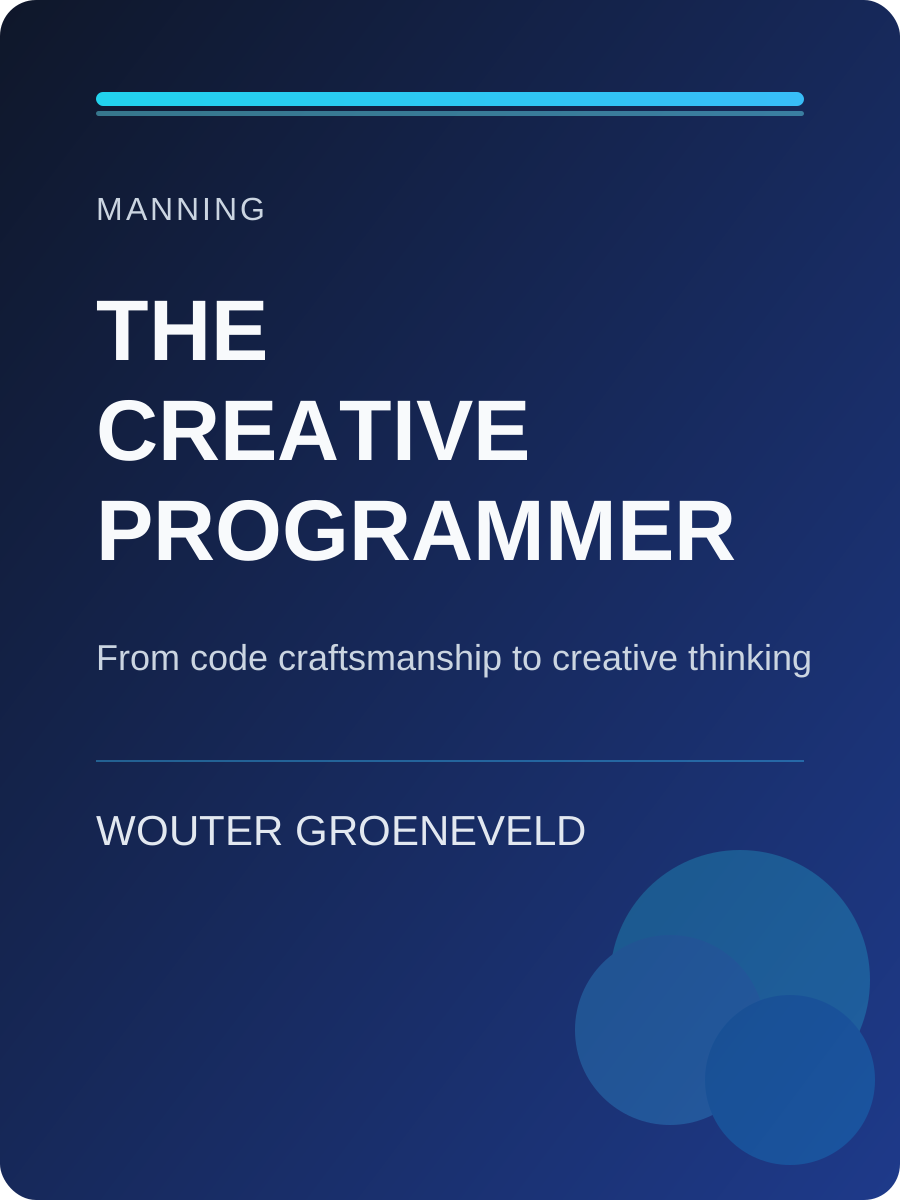 Original
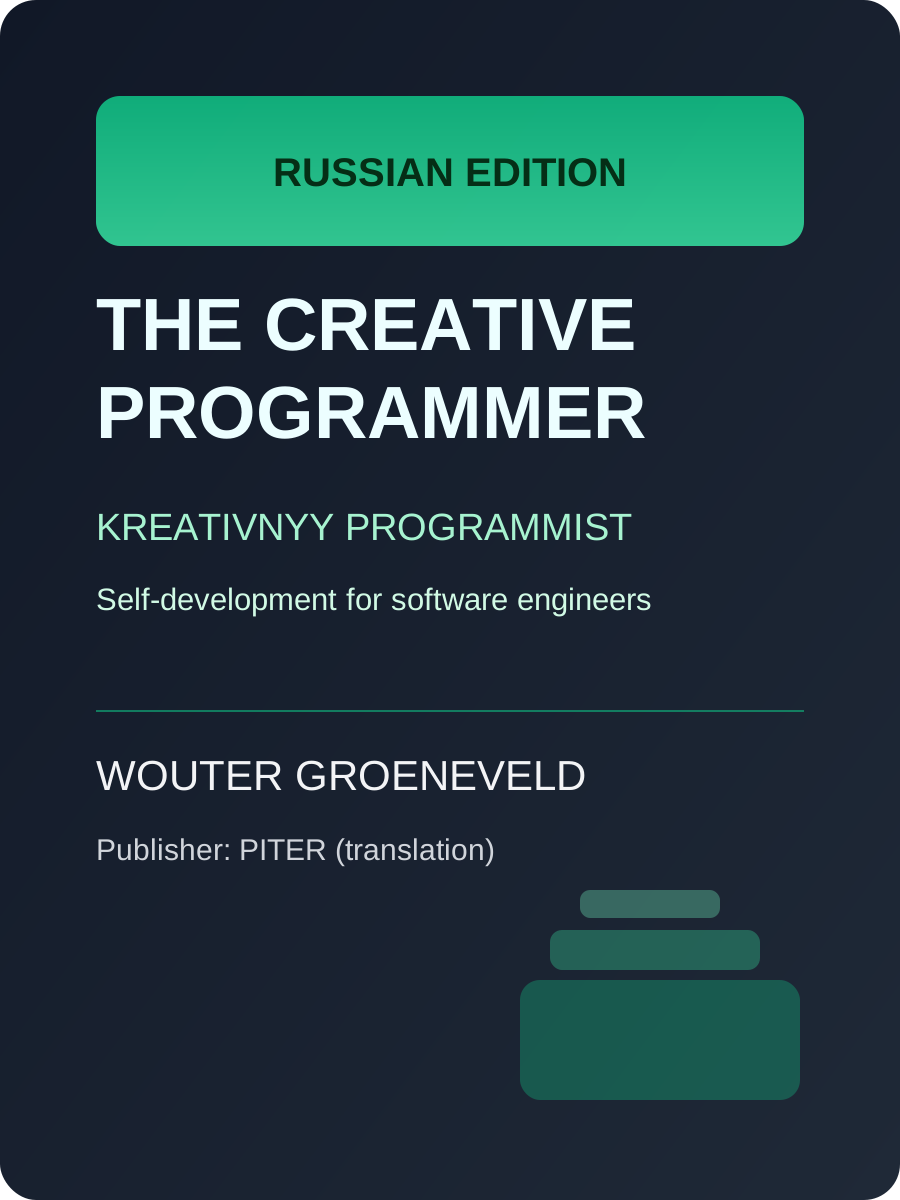 Translation
Brief
The essential idea
The Creative Programmer treats software development as a creative practice comparable to writing or music. Creativity is not presented as an innate gift: it can be developed through technical knowledge, collaboration, constraints, critical thinking, curiosity, a productive state of mind, and deliberate creative techniques.
Strong ideas often emerge where engineering meets design, psychology, or product thinking. Borrowing an approach is useful when it is adapted to the domain instead of copied blindly, and external constraints can sharpen a solution when they are balanced with intrinsic motivation and time for reflection.
The practical toolkit combines a writer's notes, an artist's metaphors and visualization, and an engineer's testable experiments. Progress can be discussed through the Creative Programming Problem Solving Test, while weekly ideation, an idea journal, explicit success criteria, and short feedback loops turn creativity into repeatable team practice.
Decision lens
Key takeaways
Engineering creativity is a capability that can be practiced rather than a fixed personal trait.
Technical depth provides the foundation for useful unconventional solutions.
Collaboration and early feedback combine perspectives and expose weak assumptions.
Constraints can stimulate simplification and innovation instead of merely restricting a team.
Critical thinking distinguishes an interesting idea from a workable engineering choice.
Curiosity across disciplines expands the space of possible solutions.
Creative techniques are most useful when paired with experiments and measurable feedback.
Workplace experiment
Apply it at work
- 1
Hold a weekly ideation session that produces at least three alternatives and explicit trade-offs for one current problem.
- 2
Keep a personal idea journal for observations, analogies, and hypotheses that would otherwise be lost in operational work.
- 3
Give each new idea a time box, a success criterion, and a concrete validation method.
- 4
Use the Creative Programming Problem Solving Test periodically and discuss changes in a retrospective or one-to-one.
Choose one action, define the observable effect, and keep the first test small enough to reverse.
Evidence
Sources and further reading
Additional sources
Channel, aggregator, and commentary links confirm the work; they are not the primary source.