
Visual Meetings
Authors: David Sibbet
Publisher: Wiley
Length: 2010
David Sibbet on visual facilitation: shared working surfaces, discussion patterns, and templates that accelerate group understanding and decisions.
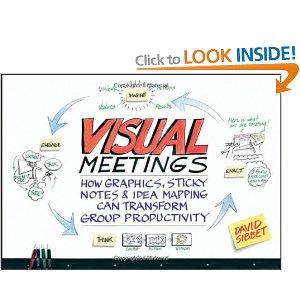 Original
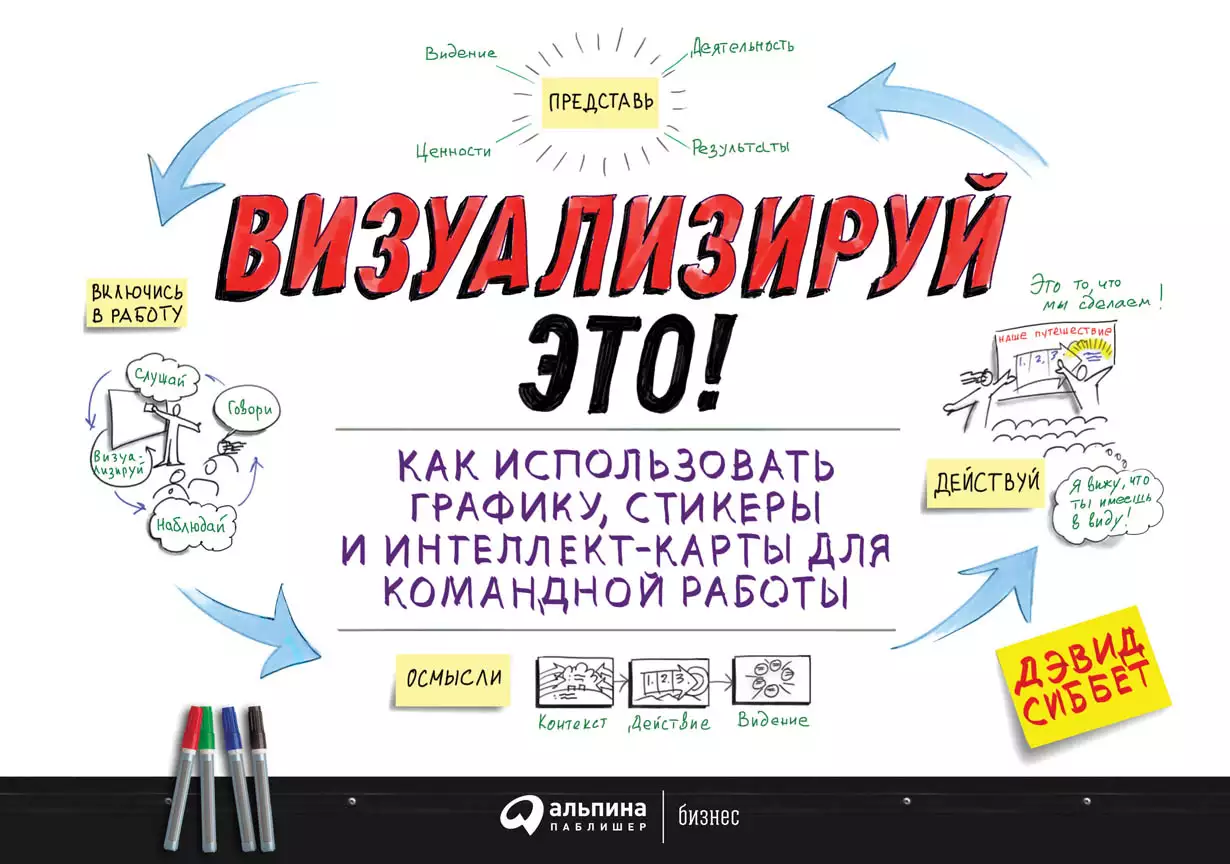 Translation
Brief
The essential idea
David Sibbet's Visual Meetings explains how groups make better decisions when thinking is externalized on a shared visual surface. Context, options, risks, criteria, decisions, owners, and next steps can be visible at the same time, reducing verbal repetition and making disagreements and trade-offs easier to examine.
The facilitator progresses from capturing discussion to structuring dialogue, managing energy, aligning the group, designing sessions, and building a durable meeting system. A small visual vocabulary—points, lines, rectangles, clusters—and reusable patterns such as timelines, Venn diagrams, two-axis matrices, agenda boards, clustering, journeys, stacks, and networks should be selected for the question rather than used decoratively.
Decision lens
Key takeaways
A shared visual artifact gives the group one field for context, options, risks, and action.
Visible arguments and trade-offs improve decision transparency and make commitment easier.
Facilitation is a progression from note-taking to deliberate session and meeting-system design.
The visual form should match the question: who or what, how much, where or when, how, and why or if.
Clustering, journeys, ranking, and networks support different modes of group reasoning.
Every session must end with an explicit decision, owner, deadline, and next step.
Visual artifacts belong beside RFCs and ADRs as part of the team's engineering memory.
Workplace experiment
Apply it at work
- 1
Choose a timeline, Venn diagram, matrix, agenda board, or other template before the next complex meeting.
- 2
Place decision criteria on the shared surface alongside ideas and alternatives.
- 3
Use a consistent minimal legend for facts, relationships, options, groups, and risks.
- 4
Finish the session by highlighting decisions, owners, dates, and the immediate next step.
- 5
Store the final visual artifact with the relevant RFC, ADR, incident record, or migration plan.
Choose one action, define the observable effect, and keep the first test small enough to reverse.
Evidence
Sources and further reading
Primary source
Additional sources
Channel, aggregator, and commentary links confirm the work; they are not the primary source.