
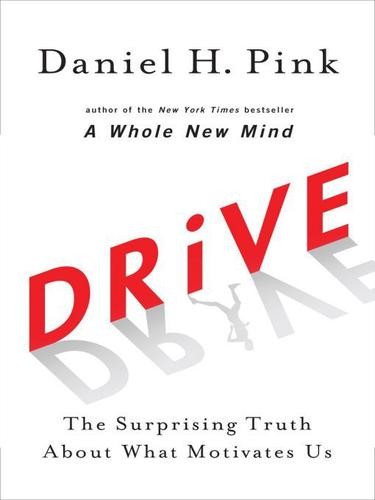
Drive: The Surprising Truth About What Motivates Us
Authors: Daniel H. Pink
Publisher: Riverhead Books
Length: 2009
Intrinsic motivation, autonomy, mastery, and purpose, and the manager's role in sustaining the team.
 Original
Brief
The essential idea
Developer motivation is a property of the working system rather than a mood a manager can repair with a bonus or an inspiring speech. The principal–agent model explains why crude evaluation makes both company and engineer optimize what is visible instead of what is valuable; repeated-game thinking shows why stable rules and long-term trust make cooperation rational.
Narrow KPI systems often reward task counts while sacrificing reliability, architecture, and technical debt, and they invite metric gaming and hidden problems. A healthier environment combines purpose, autonomy within clear boundaries, mastery through challenging work and feedback, fairness in evaluation, belonging, and visible progress.
Long-term motivation requires a coherent operating system: hire for the context, connect work to business and user outcomes, make decision rights explicit, maintain a feedback cadence, and show the next career step. The leader's role is to create conditions in which high-quality work and honest signaling are the sensible strategy for everyone.
Decision lens
Key takeaways
Motivation is designed through context, incentives, trust, and growth opportunities.
Crude KPIs encourage optimization of observable activity rather than durable value.
Purpose, autonomy, mastery, fairness, belonging, and progress reinforce one another.
Autonomy requires explicit decision boundaries rather than vague permission.
Regular one-to-ones and transparent career expectations reduce uncertainty and opportunism.
Harmful processes and a toxic context cannot be repaired with motivational perks.
Workplace experiment
Apply it at work
- 1
Diagnose motivation through interviews, pulse surveys, and retrospectives grounded in specific work episodes.
- 2
Select three or four system changes across context, autonomy, feedback cadence, and growth.
- 3
Make evaluation and career criteria explicit and give people projects that exercise the next level.
- 4
Review turnover risk, eNPS, delivery speed, and quality after eight to twelve weeks.
Choose one action, define the observable effect, and keep the first test small enough to reverse.
Evidence
Sources and further reading
Additional sources
Channel, aggregator, and commentary links confirm the work; they are not the primary source.