
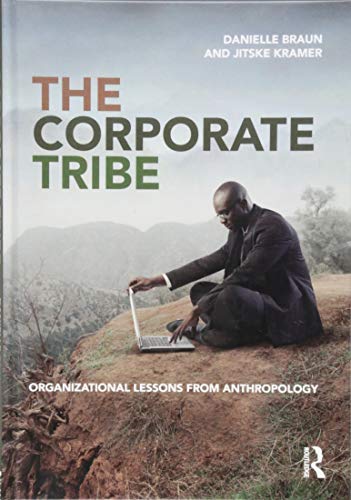
The Corporate Tribe
Authors: Danielle Braun, Jitske Kramer
Publisher: —
Length: —
Culture, values, and informal tribes inside companies, and how they influence outcomes.
 Original
 Translation
Brief
The essential idea
The Corporate Tribe applies anthropology to organizations because strategy ultimately depends on behavior. Culture lives in local language, unwritten rules, rituals, status, conflict, and the informal leaders through whom trust and influence flow.
The chapter contrasts quick typologies and cultural dimensions with contextual fieldwork. An emic view asks how participants explain their own actions; an etic view relates those observations to models and business goals. Interviews about real episodes, observation of meetings and conflicts, and influence mapping reveal more than a survey alone.
Change follows a cycle of Diagnose, Interpret, Design, and Iterate. Leaders map actual behavior and tribal boundaries, explain the mechanisms that preserve them, introduce small changes to roles, rituals, and relationships, and repeat until new behavior becomes stable.
Decision lens
Key takeaways
A company is a network of tribes, not only a formal org chart.
Daily behavior and informal rules can override a formally correct strategy.
Emic and etic views combine insider meaning with an external analytical frame.
Informal leaders and bridges between product, engineering, security, and operations are critical change channels.
Culture changes through repeated social interventions, not a top-down announcement.
Progress should be measured in behavior and relationships, not only new process artifacts.
Workplace experiment
Apply it at work
- 1
Interview people about specific decisions, conflicts, and escalations rather than asking abstract culture questions.
- 2
Observe meetings and map the people who actually move decisions across organizational boundaries.
- 3
Make decision rights, escalation routes, and shared measures explicit between neighboring tribes.
- 4
Run one small ritual or relationship intervention and inspect the behavioral effect before scaling it.
Choose one action, define the observable effect, and keep the first test small enough to reverse.
Evidence
Sources and further reading
Additional sources
Channel, aggregator, and commentary links confirm the work; they are not the primary source.